A Local Guide to Whitefish Bay Home Styles
May 28, 2026
May 28, 2026
If you are drawn to homes with character, Whitefish Bay stands out right away. This is a village where architecture is not just background scenery, but a major part of the home search itself. Whether you love classic revival styles, early 20th-century houses, or the occasional modernist surprise, understanding the local housing mix can help you shop with more clarity and confidence. Let’s dive in.
Whitefish Bay is a compact village with a predominantly single-family housing stock, and that shape matters when you start comparing homes. The village incorporated in 1892, and its growth over time created a layered mix of early houses, revival-era homes, and later infill on different streets.
Architecture also has unusual visibility here because preservation is part of the local landscape. Whitefish Bay created its Historic Preservation Commission in 2005, and the village commissioned an intensive architectural survey in 2010. A summary of that work noted that nearly 2,900 historic houses were photographed and that almost 75% of the village had potential National Register significance.
For you as a buyer, that means style, era, and original details often matter as much as square footage. In Whitefish Bay, two homes with similar size can feel very different depending on their architectural integrity, street context, and lot conditions.
Whitefish Bay is best understood as a village with several architectural layers. The broad pattern is early Queen Anne and Foursquare homes, followed by a large middle of Colonial Revival, Tudor Revival, and bungalow houses, plus smaller pockets of Mediterranean, International Style, and Usonian design.
If you want some of the village’s earliest surviving residential fabric, these are key styles to know. East Day Avenue is one of the clearest examples, with Architecture and History Inventory records that include an 1892 Queen Anne house and an 1896 American Foursquare.
Queen Anne homes often read as more ornate and visually varied in form, while Foursquare houses usually feel more symmetrical and straightforward. In Whitefish Bay, these homes can appeal to buyers who want a strong sense of age, early village history, and original neighborhood pattern.
Colonial Revival is the most prolific style in Whitefish Bay, according to the survey summary. Architecture and History Inventory records show it recurring on Lake Drive from the 1920s through the 1950s.
For many buyers, this is the style that defines the village’s classic look. These homes often present a composed, timeless exterior and tend to fit naturally into Whitefish Bay’s established streetscape, especially along more prominent corridors.
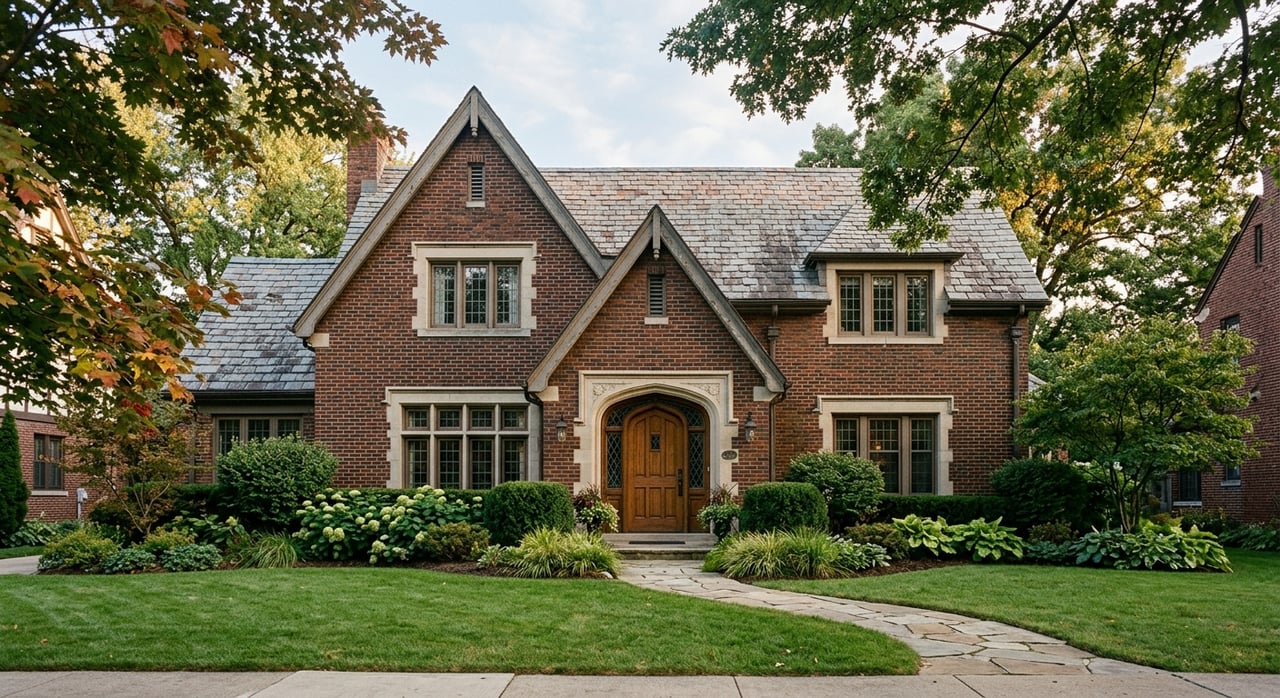
Tudor Revival was identified as the second most prolific style in the village survey summary. Whitefish Bay examples appear on Lake Drive, Shoreland Avenue, and Silver Spring Drive, with many dating to the 1920s and 1930s.
These homes often stand out for their strong rooflines and storybook character. If you are looking for a house with a distinct architectural identity, Tudor and English Revival homes are one of the most recognizable parts of the Whitefish Bay market.
Bungalows show up across interior residential streets including Birch, Idlewild, and Shoreland. Surveyed examples date from 1913, 1926, and 1927, which helps place them in the village’s broader early-to-middle growth period.
For buyers who want a smaller footprint, efficient layout, or a more casual architectural feel, bungalows can be especially appealing. They also help explain why Whitefish Bay does not feel visually uniform from block to block.
These are less common than Colonial or Tudor homes, but they are part of the local mix. Whitefish Bay includes 1920s-era Mediterranean or Spanish examples on Cumberland Boulevard and Silver Spring Drive.
Because they are less common, these houses can feel especially distinctive in your search. If you value architectural variety, this style adds another layer to the village’s design appeal.
Whitefish Bay also has a small but notable modernist footprint. Surveyed examples include 1937 and 1940 International Style houses and a 1950 Usonian house on Shore Drive.
That matters because Whitefish Bay is not only a market for traditional architecture. If your taste leans more modern, there are selective opportunities here, though they are clearly the exception rather than the rule.
In Whitefish Bay, the street you choose can influence the kind of architecture you see just as much as your budget or size goals. Certain streets are tied closely to certain eras, and that can help you narrow your search more strategically.
East Day Avenue is one of the clearest places to see the village’s oldest housing stock. If your priority is an earlier home with roots close to the village’s first residential phase, this is one of the most relevant reference points.
That does not mean every house there will match the same style or condition. It does mean the street helps illustrate where Whitefish Bay’s early architectural story is easiest to read.
Lake Drive reads differently from many interior blocks. It is more closely associated with upper-scale revival homes, and records include at least one three-acre bluff estate at 5270 N. Lake Dr.
For buyers, this corridor tends to feel more formal and more estate-like in places. It also reflects how house style, lot size, and setting can work together differently near the lake edge than they do deeper in the village.
These streets show more of Whitefish Bay’s mixed architectural layering. Here, you can see a broader spread of bungalow, English Revival, Mediterranean, International, and Usonian houses, along with later infill.
If you want variety in your search, these areas can be especially useful to explore. They show that Whitefish Bay is not a one-style market, even if Colonial and Tudor homes tend to dominate the overall picture.
Whitefish Bay’s east lakeshore edge has a distinct feel, and there is a historical reason for that. After the Pabst resort closed in 1914, the former shoreline resort land was subdivided into 17 residential lots in 1915.
That history helps explain why the former resort shoreline can feel different from interior village blocks. When you tour homes near the lake, you are often seeing a different development pattern, not just a different price point.
Architecture may draw you in, but lot standards can shape what is possible after closing. In Whitefish Bay, zoning helps explain why some homes feel more estate-like while others sit on tighter, more compact sites.
The village zoning map includes Lake Shore Residence, single-family, two-family, apartment, business, and Silver Spring Drive business districts. For buyers focused on single-family homes, the Lake Shore Residence District, District 1A, and District 2 are especially relevant.
In the Lake Shore Residence District, each lot must extend from the public street or district boundary to Lake Michigan. It must also contain at least 9,600 square feet and average at least 80 feet in width.
These standards help explain the larger-scale relationship between house and site along the lakefront. If you are comparing a lakefront property to an interior-village home, the lot framework can be very different from the start.
In District 1A, the minimum lot width is 50 feet and the minimum lot area is 6,000 square feet per single-family dwelling. This gives you a useful baseline when you are evaluating how much site flexibility a home may have.
For buyers thinking ahead to additions or exterior changes, these dimensions can matter as much as the home’s style. A beautiful house on a tighter lot may come with more practical limits than you first expect.
In District 2, the minimum is 40 feet of frontage and 4,800 square feet south of East and West Montclaire Avenue. North of Montclaire, the minimum is 50 feet of frontage and 120 feet of depth.
Annexed territory defaults to District 2. If you are comparing homes across different parts of the village, these district differences can help explain changes in lot rhythm, spacing, and renovation potential.
In a place like Whitefish Bay, the real question is often not simply whether a house is old. It is whether the original composition still reads clearly through the exterior, massing, and architectural details.
That is one reason design-minded buyers tend to look beyond finishes and focus on the bones of the house. A home with a legible original style can offer a stronger sense of place and, in many cases, a more coherent long-term renovation path.
The village’s survey work and Architecture and History Inventory also make it smart to confirm whether a property is inventoried or locally designated before planning major exterior changes. If preservation status is part of the picture, you will want that information early in your decision-making process.
If you are home shopping in Whitefish Bay, it helps to search by both style and street. Instead of only filtering by bedrooms or price, think about the architectural experience you want day to day.
You may be drawn to an early Queen Anne or Foursquare on East Day Avenue, a classic Colonial Revival or Tudor on Lake Drive, a bungalow on an interior block, or a rarer modernist home tucked into a mixed street. The more clearly you define your design priorities, the easier it becomes to spot the right fit when inventory is limited.
Whitefish Bay rewards buyers who pay attention to context. House style, street history, lot dimensions, and preservation considerations all work together here, and understanding that mix can help you make a better, more confident move.
If you want help narrowing your search around architecture, lot potential, and the feel of specific Whitefish Bay blocks, Kelton Hatton offers a thoughtful, design-aware approach to buying and selling across the North Shore.
Stay up to date on the latest real estate trends.
Get assistance in determining current property value, crafting a competitive offer, writing and negotiating a contract, and much more. Contact Kelton today to discuss all your real estate needs!