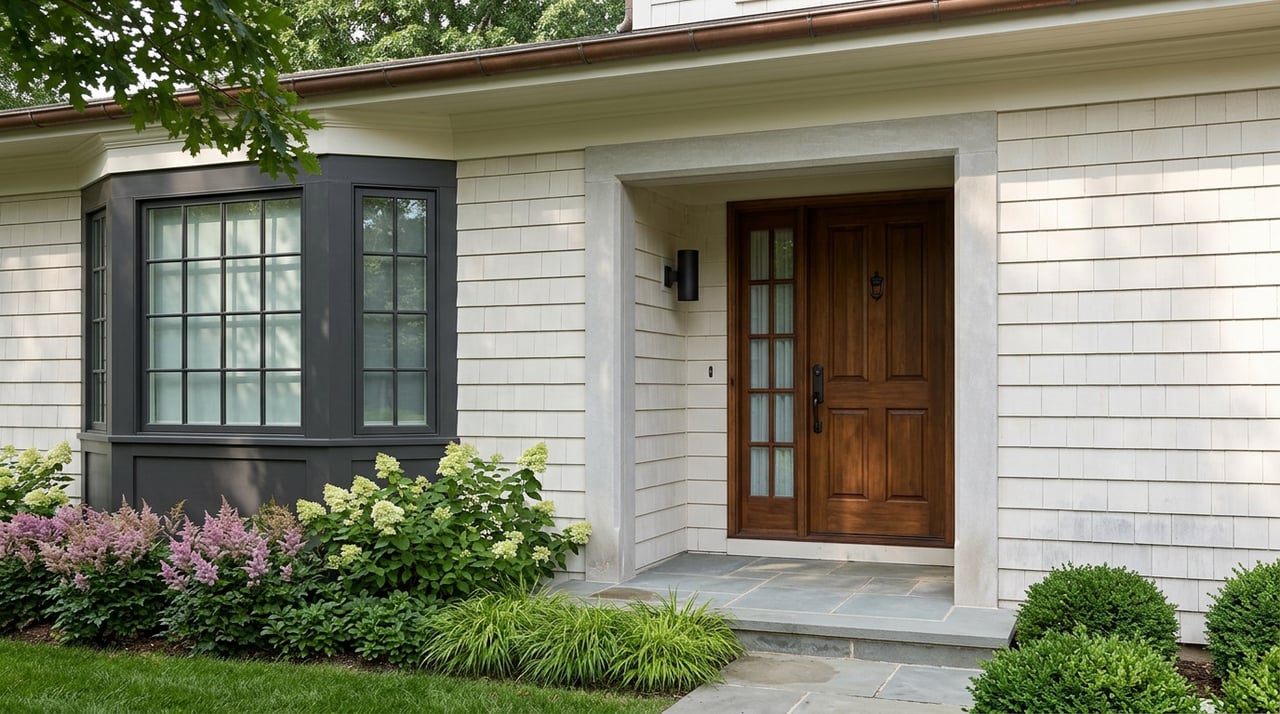
The Two Disclosure Lines That Decide a Bayside Closing in 2026
August 6, 2026
August 6, 2026
A Bayside listing that closes cleanly in the second half of 2026 tends to look the same on paper as one that stalls at inspection. Same block, similar square footage, comparable staging. The difference usually sits on two lines of the Wisconsin Real Estate Condition Report that sellers in Fox Point or Whitefish Bay almost never have to think about, and that Bayside sellers routinely overlook until a buyer's attorney flags them.
The market has raised the cost of both mistakes. In the four-county Milwaukee metro, June 2026 closed prices rose only 2.4 percent year over year, active inventory ran roughly 40 percent above the prior June at close to 2,000 listings, and 275 listings expired without selling that month. Well-priced homes still cleared in about five days, but a mid-inspection surprise no longer disappears into a bidding war. It becomes a credit request, or the reason a buyer walks.
Bayside is served by the Milwaukee Metropolitan Sewerage District for sanitary sewer, so the septic conversation that dominates further-out communities rarely comes up. What does come up, again and again, is the intersection of two very local facts:
Neither shows up in a portal listing. Both show up in a well-run buyer inspection.
The Wisconsin WB-24 Real Estate Condition Report is not a warranty. It is a disclosure of what the owner knows. Chapter 709 of the Wisconsin Statutes requires the completed report to reach the buyer within ten days of offer acceptance, or the buyer has a statutory right to rescind. Real estate licensees cannot advise the seller on how to answer any specific question. That last constraint is why the well line, in particular, tends to sit blank or drift toward "not applicable" when it should not.
The form's environmental section asks the owner to affirm awareness of well water quality problems and, separately, whether the property is served by a joint well. Both questions map to conditions common in Bayside's lower-density, deeper-lot streets, where a home built on a private well in 1958 may have quietly stayed on that well even after the municipal main arrived.
The Wisconsin State Laboratory of Hygiene handles routine private well testing for coliform, nitrates, and metals, and homeowners can request kits directly. In Bayside, the Village explicitly directs residents there for well testing.
A seller who lists without a recent water test hands the buyer's inspector the first move. A seller who provides a clean six-month water panel and, where relevant, documentation that a decommissioned well was properly abandoned under Wisconsin DNR guidelines removes the negotiation before it starts.
The second line is not on the WB-24 at all. It sits in the tax bill.
The Village of Bayside ran water connection special assessment programs in 2013 and 2015 for properties that connected to the municipal system, and residents could finance the connection cost through what the Village calls a B-Bond. Those bonds are still being paid. The final 2013 assessment is scheduled for the 2032 tax bill payable in 2033, and the final 2015 assessment for the 2034 tax bill payable in 2035. Some properties still show the annual line item; others have prepaid.
The wrinkle for a 2026 closing is the Village's stated policy at transfer:
| Program year | Final assessment year | Payable through | Village posture at sale |
|---|---|---|---|
| 2013 water connection | 2032 tax roll | 2033 | Payoff not required |
| 2015 water connection | 2034 tax roll | 2035 | Payoff not required |
Because the Village does not require a payoff at closing and treats the outstanding balance as a private matter between buyer and seller, it becomes exactly the sort of unresolved dollar figure that widens at inspection. A buyer who learns about the assessment on the day of the pre-closing tax proration reads it, correctly, as leverage. A seller who has already pulled the payoff quote from Village Hall at 414-206-3915 and stated the number in the listing packet reads it, correctly, as a non-event.
For most of 2024 and 2025, Bayside sellers priced against a market that absorbed small friction points at the offer stage. That is no longer the current market. Year-to-date metro appreciation is still healthy at roughly 6.65 percent through June, but the June reading itself was one of the weakest summer months in years, and demand is now sorting hard between clean, well-priced listings and everything else. The Wisconsin REALTORS Association housing statistics tell the same story at the state level.
For a Bayside seller, "clean" no longer means only staging and paint. It means the buyer's inspector and attorney find no open questions in the disclosure packet. Where 2024's market forgave a blank well line and a footnoted assessment balance, 2026's market treats each of them as a discount opportunity.
The demand side is not weakening. The Architectural Review Committee has been reviewing a Cobalt Partners and Rinka Architecture proposal for a mixed-use building on Port Washington Road, with a fitness club, a full-service grocer, and residential apartments, and the developer's team noted that the nearby Symphony Apartments are already 95 percent leased. That kind of amenity gravity holds Bayside's ceiling in place. What has changed is buyer patience with unresolved paper.
For a Bayside owner planning to be on the market this fall or next spring, the sequence that consistently protects seller leverage looks like this:
Each of these moves converts a potential inspection-period concession into a piece of paper already in the buyer's hands before the offer is written.
What if the home is being sold from a trust or estate? Wisconsin Statute 709.01(2) exempts a personal representative, trustee, conservator, or court-appointed fiduciary from delivering the RECR, provided that person never occupied the property. The sale should be marketed as-is from listing day. Buyers can still inspect and negotiate credits, but the seller is not answering line-item disclosures they have no personal knowledge of.
Can I answer "not applicable" on the well line if I use municipal water? Only if there is no well on the property, current or historic. A capped or abandoned well is still a disclosable condition, and buyers' inspectors routinely find the wellhead or vault during a site walk. If a former well exists, disclose it and document the abandonment.
Does the B-Bond show up in a title search? It appears as a special assessment on the tax bill rather than as a separate lien of record, which is why buyers and their attorneys sometimes miss it until the tax proration is calculated at closing. Producing the Village payoff quote during listing preparation removes any surprise.
Bayside rewards sellers who arrive at the market with the paper already in order. If you are weighing a listing this year, Kelton Hatton can walk your property, pull the assessment and well documentation with you, and coordinate the presentation work that keeps a 2026 buyer focused on the home rather than the disclosures. Request a free home valuation to start the conversation.
Stay up to date on the latest real estate trends.




Get assistance in determining current property value, crafting a competitive offer, writing and negotiating a contract, and much more. Contact Kelton today to discuss all your real estate needs!